



08 July, 2026
Teaching Students to Think Like Problem-Solvers, Not Just Pass Exams
.jpg?h=1200&iar=0&w=1800&rev=eaa4e5507486436cb7eedb1f1f44697c&hash=5C6F09D79A3AF0AD6D1FBEE48AB4FC06)
.jpg?h=249&iar=0&w=374&rev=2cdc7327560f4c80b14a3bfd2be23cfa&hash=7E4E151DDFCBB0F5DCCB44342C224106)
One of the greatest challenges facing education today is preparing young people for a world where information is available in seconds. Questions can be answered instantly by search engines and AI.
The ability to think critically, evaluate evidence and solve unfamiliar problems is a skill that we as humans are in danger of losing. Education must go beyond passing exams. It should focus on developing thoughtful, analytical and resilient problem-solvers.
“When Will I Ever Need This?”
A common question heard in classrooms everywhere.
The answer is not found in one specific fact or formula. Instead, it lies in how scientific thinking helps students understand the world around them and confidently question the information they encounter.
Bringing Science to Life
Nothing captures a student's attention quite like seeing a marshmallow placed inside a vacuum chamber and watching it expand. In that moment, pressure is no longer just a definition in a textbook. It becomes something memorable and real.Similarly, standing waves are no longer abstract lines on a page when students see how the same principles apply to musical instruments or even heating food in a microwave. These physical demonstrations help students bridge the gap between theory and reality. They encourage curiosity, spark questions and build meaningful connections.
Curiosity at the Centre of Learning
These experiences are designed not only to engage, but to develop curiosity.
From Year 9 onwards, students are encouraged to think beyond simply finding the right answer. Lessons are often built around questions such as:
- “What happens when...?”
- “What happens if...?”
- “Why?”
Building Deeper Thinking
These seemingly simple prompts push students to think more deeply. They learn to predict outcomes, justify their reasoning and challenge assumptions. Understanding becomes about more than memorising facts. It becomes about applying knowledge in unfamiliar situations.Over time, these habits evolve into the analytical skills required for A Level study. Students learn to construct detailed explanations, combining knowledge, evidence and logical reasoning to solve increasingly complex problems.
Thinking in an Age of AI
This approach is especially important in a world where the default response to uncertainty is often, “I’ll just look that up.”Search engines and AI tools are valuable resources. However, they should support thinking, not replace it. If students become too reliant on simply retrieving information, they risk missing the deeper skills needed to evaluate whether that information is reliable, relevant or even correct.
Navigating a World of Information
In an age of misinformation, clickbait headlines and conflicting online sources, the ability to think critically has never been more important.
Through Physics, students learn how evidence is gathered, how conclusions are formed and how theories are tested. They are encouraged to follow a structured approach:
- Observe the evidence
- Interpret the findings
- Evaluate the conclusions
Skills for Life, Not Just the Classroom
These steps reflect the work of scientists and engineers. More importantly, they mirror the skills needed to navigate everyday life. Whether assessing a claim on social media, interpreting statistics in the news or weighing up competing arguments, students must be able to distinguish evidence from opinion and conclusions from assumptions.
Preparing for the Future
Ultimately, our goal is not simply to produce students who can answer examination questions.
It is to develop young people who are confident asking questions of their own, and who have the skills to find meaningful answers.
Examinations may measure what students know at a single moment in time. Problem-solving, curiosity and critical thinking equip them for a lifetime.
Related news
News image ![Why Psychology Is One of the Most Important Subjects for the Future | OIC Brighton - Why Psychology Is One of the Most Important Subjects for the Future]() Blog
Blog
 Blog
Blog Why Psychology Is One of the Most Important Subjects for the Future
We explore why Psychology remains one of the most valuable subjects for students, developing critical thinking, scientific literacy and a deeper understanding of human behaviour in a rapidly changing world.
News image ![Oxford International College Brighton Celebrates Outstanding GCSE Results - Oxford International College Brighton GCSE Results 2026]() News
News
 News
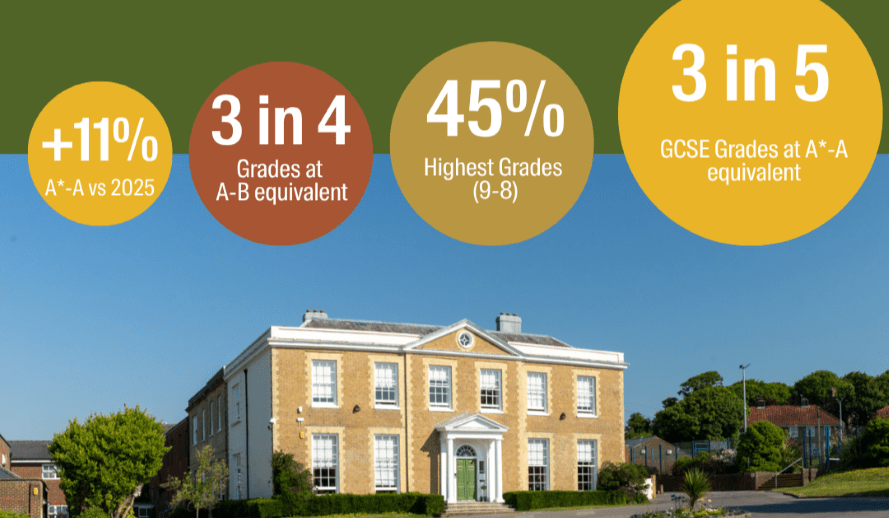
News Oxford International College Brighton Celebrates Outstanding GCSE Results 2026
Students at Oxford International College Brighton are celebrating an exceptional set of GCSE results, with 62% of all grades awarded at A*/A equivalent level and three quarters of grades awarded at the equivalent of A*-B.
News image Blog
Starting Boarding School Near Brighton | A Practical Guide for Families
Thinking about boarding school near Brighton? This guide covers the Ovingdean campus, what to expect, a before-you-arrive checklist and what to pack for life on the Sussex coast.
News image ![OIC Brighton Students Secure Places at Cambridge and Leading Global Universities Following Outstanding A Level Success | OIC Brighton - OIC Brighton Students Secure Places at Cambridge and Leading Global Universities]() Blog
Blog
 Blog
Blog OIC Brighton Students Secure Places at Cambridge and Leading Global Universities Following Outstanding A-Level Success
With one in three students achieving three or more A/A* grades and destinations spanning the UK, Europe, North America and Asia, the Class of 2026 has demonstrated outstanding academic achievement and ambitious futures.